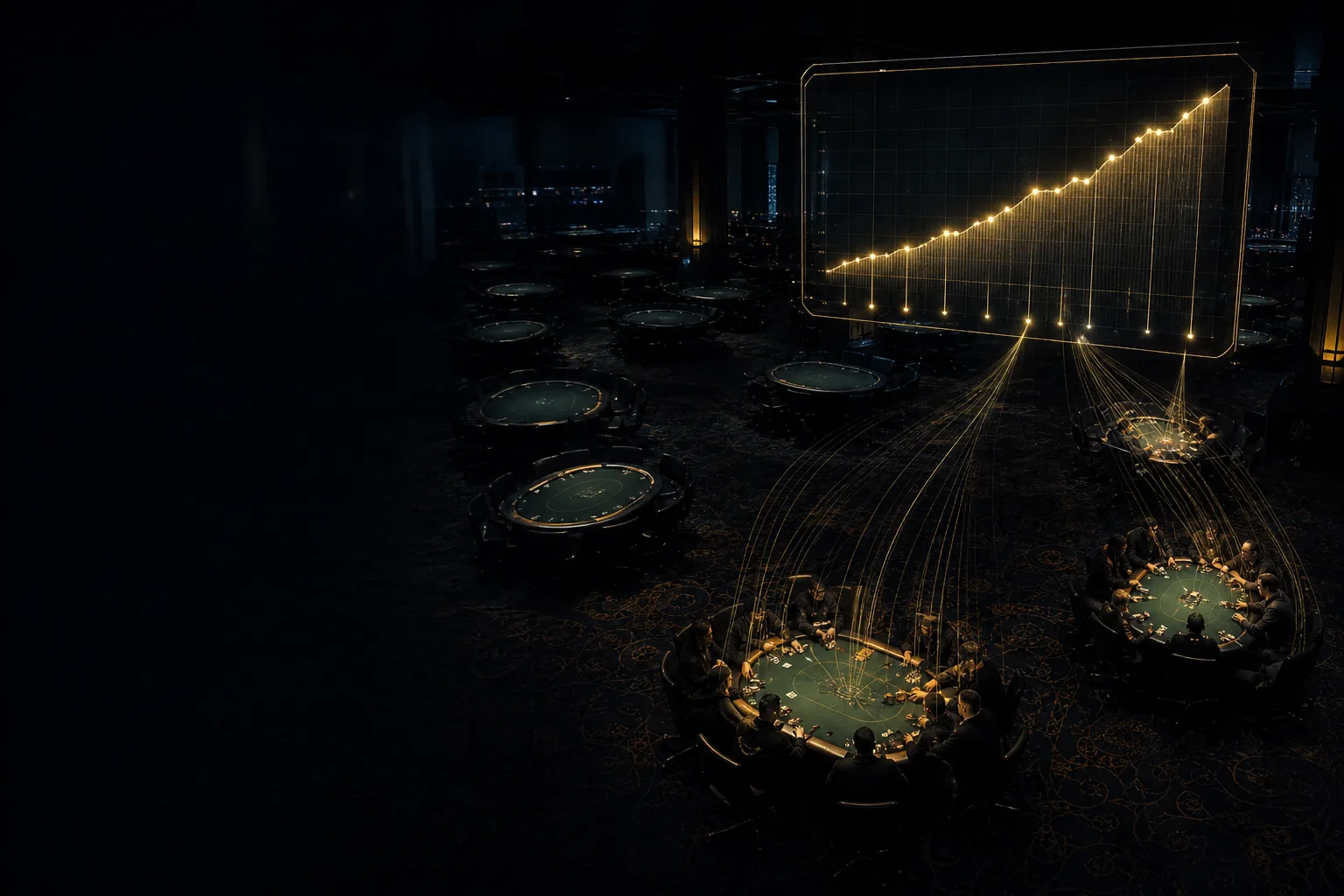
Off-peak rake growth means closing the gap between what a club earns at 3am and what it earns at 9pm. For most clubs, that gap is 70–80% — not the 40% most owners estimate. A club that recovers even half of that gap through managed AI infrastructure adds $20,000+ per month in rake without acquiring a single new player. This article explains why manual props and DIY scripts fail to close that gap systematically, and how AI table activity infrastructure works in practice.
The "dead hours" problem
Almost every poker club faces the same issue: between 2:00 and 8:00 AM (in the primary audience's time zone), online activity drops 3–5x. Tables collapse, active players migrate to other platforms, and open seats sit empty.
For a club, this isn't just "missed rake" — it's a systemic loss. Players who showed up at night and didn't find live tables are highly likely to not come back. That's a direct hit to retention and LTV.
Quantifying the off-peak revenue gap
The numbers behind dead hours are usually worse than club owners estimate. A club generating $400/hour in rake during peak (8pm–1am local) commonly drops to $80–120/hour between 3am and 7am. That's not a 40% decline — it's a 70–80% revenue cliff that lasts 5–6 hours every single night.
Multiplied out: a club losing $250/hour for 6 off-peak hours is leaving roughly $45,000/month on the table compared to a flat 24/7 baseline. Even recovering half of that gap — bringing off-peak rake to 50% of peak instead of 20% — adds $20,000+ in monthly revenue without acquiring a single new player. This is precisely the gap AI poker bots are supposed to close, though as we'll cover below, not every implementation actually delivers.
The compounding problem is worse than the direct loss. Regulars who log in at 2am, see three half-empty tables, and close the app don't just skip that session — they shift their habit. Within 4–6 weeks they've migrated to a competitor with deeper night-time lobbies. Once that habit forms, even strong peak-hour activity won't bring them back. Off-peak retention is upstream of LTV; clubs that ignore it are silently churning their highest-value players without seeing the cause in their dashboards.
Why manual bots don't solve it
The classic approach is to hire "solo" operators who manually keep tables alive during night hours. But this approach has hard limits:
- Instability: operators get tired, distracted, and can't sustain multi-hour sessions at quality.
- Expensive: at the scale of a club network, the operator payroll becomes a significant cost center.
- Doesn't scale: adding 10 tables = hiring 10 people.
- No analytics: it's impossible to accurately measure an individual operator's contribution to rake growth.
Why DIY scripts fail too
Some operators try the opposite extreme — replacing manual props with self-built poker bots running on a spare laptop. The economics look attractive on paper: no payroll, runs all night, scales by spinning up more instances. In practice the failure mode is consistent and predictable.
Scripts break on every app update, and PPPoker, PokerBros, and ClubGG ship updates every 2–4 weeks. They play deterministically, which makes them detectable to anyone watching the table. They can't adapt to live conditions: a bot holding a seat at a table that's about to break doesn't notice and doesn't react. And the maintenance burden falls on whoever built it, which is usually the same manager who's already running the club. We covered the detection mechanics in detail in our guide on bot activity in PPPoker anonymous clubs — the short version is that DIY scripts create more operational risk than they remove.
How AI infrastructure works
PokerNet solves the problem differently: instead of people — managed AI infrastructure that maintains table activity according to defined scenarios. Key differences:
- 24/7 operation without breaks.
- Adaptation to the specific club: formats (NLH, PLO, Short Deck), limits, schedule.
- Unified monitoring panel with all metrics.
- Scaling to club networks via Partner Mode.
On average, clubs that connect PokerNet see off-peak rake growth of 15–25% within the first month of operation.
What table activity actually looks like in practice
"AI infrastructure" is an abstraction, so it's worth getting specific about what's running during off-peak hours. The system operates on time-of-day profiles: action density, table-cap rules, and behavioral parameters all shift based on the local activity curve. At 11pm, when the lobby is still warm and regulars are arriving, AI poker bots play conservatively — they fill seats but don't drive the action. By 3am, when human players are sparse and the risk of empty lobbies is highest, the bots shift to a higher-engagement profile: more hands per hour, wider opening ranges, more multi-way pots. The goal isn't to play optimal poker — it's to keep the lobby visually active and the action density high enough that arriving players see "a club with games" rather than "a club with maybe two tables."
Configuration happens at the club level: a manager picks formats (NLH, PLO, Short Deck), limits, table caps, and operational windows. After that, the system runs without manual intervention. A unified panel surfaces the metrics that actually matter — hands per hour, seats filled, off-peak rake delta versus baseline — instead of overwhelming the operator with raw logs. The deeper technical breakdown lives in our companion piece on how AI table activity infrastructure is architected; what matters at the operational level is that off-peak hours stop being a period the club survives and become a period the club earns from.
Format-specific considerations: NLH, PLO, Short Deck
Off-peak dynamics are not identical across poker formats, and the infrastructure has to account for that. NLH lobbies recover fastest when seeded — a single active table tends to attract a second within 20–30 minutes. PLO lobbies are stickier in both directions: harder to revive when fully cold, but more stable once two or three tables are running. Short Deck operates on a different timezone profile entirely; because most Short Deck volume comes from Asian-market clubs, "off-peak" shifts 6–8 hours relative to a typical Western schedule.
The practical implication is that a single "off-peak strategy" doesn't work across formats. NLH benefits most from continuous seat-filling during the 2am–6am window. PLO clubs generally need a smaller number of high-quality stable tables rather than many marginal ones. Short Deck deployments require schedules calibrated to Asian-market evenings rather than Western mornings. We deploy format-specific AI poker bots and infrastructure for each — the mechanics for NLH, PLO, and Short Deck are documented separately because the operational decisions are genuinely different. Networks running multiple clubs across formats coordinate this through Partner Mode, which keeps configuration consistent without requiring per-club setup overhead.
Where to start
The first step is a pilot deployment over 1–2 weeks. During this period, scenarios are configured for the specific club's formats, calibration is performed, and baseline metrics are captured for comparison after connection.
Important: a pilot doesn't require separate infrastructure on the club's side. PokerNet is a ready B2B solution — the club only needs to agree on formats, limits, and schedule. The pilot tier is built specifically for clubs validating off-peak strategy before scaling; once the data shows clear rake recovery, expansion to full coverage and additional formats happens through the same dashboard, not a separate onboarding. For partner networks running several clubs, Partner Mode handles multi-club configuration as a single operation.
Common pitfalls when scaling off-peak operations
Clubs that succeed with off-peak optimization tend to share a few operational habits. Clubs that fail tend to repeat the same mistakes, and they're worth flagging before a deployment rather than after.
Overscaling too early. Adding AI poker bots to 20 tables on day one looks ambitious but masks the underlying metrics. The pilot should run on the 4–6 tables where off-peak activity matters most, with clean before/after comparisons. Once those are stable, scaling up is straightforward — but doing the opposite produces noisy data and arguments about whether anything actually changed.
Ignoring the monitoring layer. Off-peak metrics are not the same as peak metrics, and conflating them produces misleading dashboards. A club tracking only total daily rake will miss a 30% off-peak improvement if peak hours happened to dip that week. Separate baselines for peak, shoulder, and off-peak windows are non-negotiable — which is why our unified panel exposes them as distinct metrics rather than aggregated averages.
Underinvesting in configuration. The strongest results come from clubs that treat configuration as the actual product, not a one-time setup step. Limits, schedules, format mix, and table caps all benefit from iteration during the first 30 days. Clubs that connect AI infrastructure and then "set and forget" capture maybe 60% of the available rake recovery; clubs that adjust weekly during the calibration window capture closer to 100%. The work isn't huge, but it has to actually happen.